Sam Gleadhill’s PhD Confirmation of Candidature

Physiolytics and Jim’s Sports Lab team member, Sam Gleadhill is presenting his PhD confirmation of candidature this Friday (24 June). For anyone interested at CDU, please come to Red6 Room 1.01 for a 9.30 start. Griffith attendees, please go to Bray Centre Room N54_2.06 (10.00 am QLD time). This will be an interesting presentation with a combination of Sports Science and Sports Technology. I encourage you all to turn up and support Sam and see the adventure he is taking.

PHD Title:

Inertial sensor applications to monitor power and the NIOSH lifting equation during resistance exercise.

Abstract:

This confirmation of candidature presents a research proposal to validate new methods of assessing human movement parameters during a simulated work task using inertial sensors. The purpose of this research is to assess the validity of inertial sensors to be implemented in occupational settings to provide accurate, quantifiable information of resistance exercise movement patterns. The first aim of this research is to automate the NIOSH Lifting Equation with inertial sensors, by monitoring the agreement between inertial sensors, three dimensional motion capture and manual measurements. The second aim is to measure the validity of inertial sensors to monitor peak and average power, by testing the agreement between inertial sensors and gold standard methods of power monitoring. The third aim is to test the agreement between inertial sensors placed on the skin and inertial sensors embedded in clothing. It is hypothesised that inertial sensors will have a high agreement with the higher standard methods of monitoring these parameters of human movement. It is anticipated that this research will lead to a minimum of five publications to report validation results. Statistical validations will be undertaken using a Will Hopkins Typical Error of the Estimate, with a Pearson’s correlation and a Bland Altman Limits of Agreement analysis. This research will provide a foundation for inertial sensors to be applied for quantitative activity recognition of resistance exercise and safe lifting practices in occupational settings.

Posted in Uncategorized | 1 Comment

Has a new salute been evolving?

I was looking at this shot of Ali’s funeral procession and occurred to me that what I thought were hands raised in acknowledgement were actually people taking pictures – another disruption from technology…..

Screen Shot 2016-06-11 at 2.47.52 pm

This picture is a screen shot from the ABC news website  of the funeral and photo taken by John Sommersll as acknowledged in the caption.

Posted in Uncategorized | Leave a comment

ASTN-Q: Research & Innovation in Sports Technology

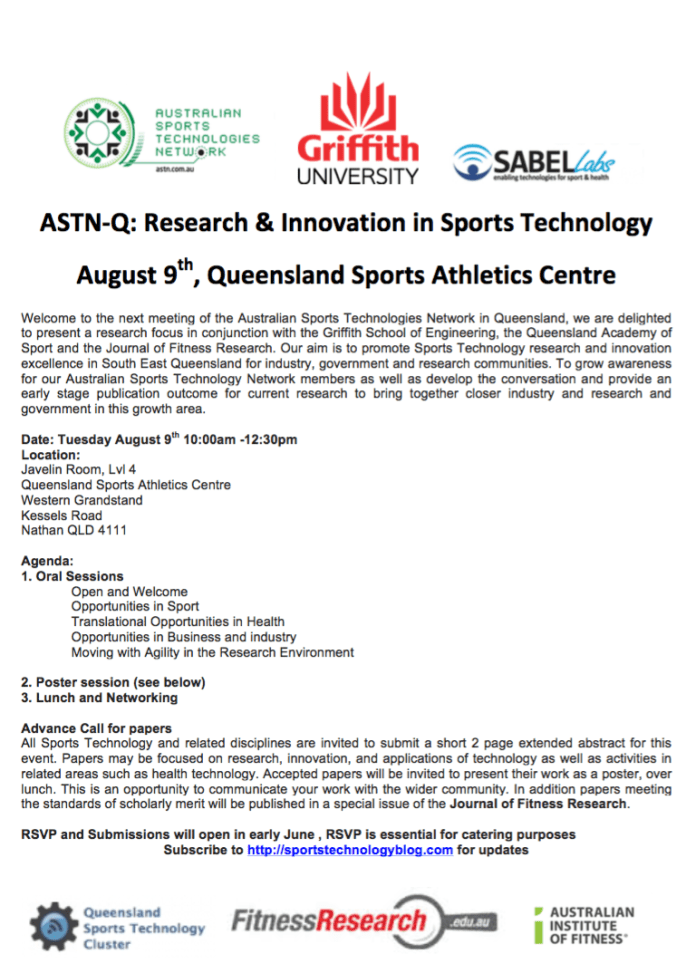
The Queensland node of the Australian Sports Technologies Network is holding a research presentation day at the Queensland Sports Athletics Centre (formally known as QE2 Stadium). Here is a link to the Queensland Sports Technology blog about the event. Any SE Queensland student should consider attending to see what is out there and begin to develop your networking skills in the industry. Researchers should also consider submitting a short communication and a sister poster presentation. If accepted, it will be included in a special edition of the Journal of Fitness Research who are supporting the seminar. It is unique as the event is one of the few places where you can present your work, gain a publication in an open access peer reviewed journal, and get lunch – all for free…… So we should all be supporting the research day as the organisations are kindly supporting us and our fields of research.

Finally, here is the flier for the event.

Screen Shot 2016-05-31 at 11.04.06 pm

Posted in Uncategorized | Leave a comment

Apps and how to pick appropriately

This is an article from today’s “The Conversation” media site. It backs up the basis of the technology review assignment in SPE205 about the need to be able to critically review technologies. I was a little surprised at the level of claims made by some.

Posted in Uncategorized | Leave a comment

Week5 Workshop for SPE205

The tech week. This week Jim has a conversation with his colleague Associate Professor Daniel James from the SABEL Labs at Griffith Uni. Danny is a world leader in the Sports Engineering world in general and with a particular interest in wearables. This is an interesting conversation. It has been deliberately created without Powerpoint slides. However, the discussion between Danny and Jim is very interesting and a lot can be taken away to better understand sports technology, where it has come from, where it is, and where it is heading too. Jim stands to be corrected, but he thinks this is the first sports technology lecture delivered to sports science students in Australia (and possibly the world) that has a particular focus on wearables.

In the Workshop, there will be demonstrations on the what outputs come from wearable technology, as well as infrared motion capture data and what we can take away from it. On top of that, Jim will talk a little more about Assessment 1 expectations.

Posted in Uncategorized | Leave a comment

journal of Biomechanics publication

A new publication titled:

“The development and validation of using inertial sensors to monitor postural change in resistance exercise”

By Sam Gleadhill, Jim Lee, and Daniel James is now in press.

Sam is a new PhD student and this work is from his Honours research. Sam now has three publications from his honours year and is well on his way to establishing himself in the field of inertial sensor technology and its applications into lifting monitoring, both in the workplace and in sporting environments. Great work Sam.

Abstract:

This research presented and validated a method of assessing postural changes during resistance exercise using inertial sensors. A simple lifting task was broken down to a series of well-defined tasks, which could be examined and measured in a controlled environment. The purpose of this research was to determine whether timing measures obtained from inertial sensor accelerometer outputs are able to provide accurate, quantifiable information of resistance exercise movement patterns. The aim was to complete a timing measure validation of inertial sensor outputs. Eleven participants completed five repetitions of 15 different deadlift variations. Participants were monitored with inertial sensors and an infrared three dimensional motion capture system. Validation was undertaken using a Will Hopkins Typical Error of the Estimate, with a Pearson’s correlation and a Bland Altman Limits of Agreement analysis. Statistical validation measured the timing agreement during deadlifts, from inertial sensor outputs and the motion capture system. Timing validation results demonstrated a Pearson’s correlation of 0.9997, with trivial standardised error (0.026) and standardised bias (0.002). Inertial sensors can now be used in practical settings with as much confidence as motion capture systems, for accelerometer timing measurements of resistance exercise. This research provides foundations for inertial sensors to be applied for qualitative activity recognition of resistance exercise and safe lifting practices.

This is available to CDU students through the CDU library and if logged on, click this link to take you article.

Posted in Uncategorized | Leave a comment

Veritasium talking about education

This is an interesting story about technology revolutionising education – a lot to ponder – especially the concept of learning. It comes back to the individual. Something I will aim to do. At least I have got the Youtube bit right….

Have a look at more Veritasium clips. Some are just entertaining, most are educational…

Posted in Uncategorized | Leave a comment

SPE205 Week3 introduction

For SPE205 students, here are two clips that are introductions and a bit of housekeeping info for assessments etc

https://www.youtube.com/watch?v=Xxb2mf7L8bs

https://www.youtube.com/watch?v=Nj2s7RdVHEs

Posted in Uncategorized | Leave a comment

Batak attack – Yet another update….

A Batak is a Sports Science tool that we can use to measure reaction, coordination, and agility of a person. Typically, when people first have a go, they score somewhere in the 20 hits in 30 secs. Here is Jim having a casual crack at it.

https://www.youtube.com/watch?v=sVD9KtO93Zk

Now here is Jim having a real crack……

https://www.youtube.com/watch?v=pAeL2Hrx7wU

The challenge is now on for CDU students and staff (and outsiders??) to match it.

BTW, Jim has now bettered this by 1!!! And his aim is to break 60. He also has a score of 522 in 300 secs (5 mins) and wishes to break 600. Can the old dog defy his age???

Another update. This week, Jimbo managed 2 PBs – midweek 539 on the 5 min setting and today 58 in 30 secs. Steady progress towards his 600 and 60 goals….. And no, I am not fudging the LEDs – I think the score lights are on the way out.

DSC_0509

DSC_0513


Posted in Uncategorized | Leave a comment

SPE205 Week 1 lecture and workshop

This week’s lecture and workshop videos are now posted in the Week1 folder in the learning materials tab in Learnline. They explain a lot about what to expect in Biomech1 this semester, including some info on the assessment items. Thanks to the internal students for participating – the workshops only work because of all of your contributions.

Posted in Uncategorized | Leave a comment